Please share your opinions and expertise since we need all the help we can get!

Sunday, July 23, 2023

Lawn and Murder Bees

Last summer, we (well, mostly I), continued to tend our vegetable garden. After protecting the garden with chickenwire and closing it off like Fort Knox to keep the rabbits out after they decimated my snap peas in 2021, we did manage to keep out most of the yard herbivores and harvest some things. Here, for example, is one of our tomato harvests. (I have many more harvest pictures from 2022 but this post isn't really about that, so imagine radishes and cucumbers too.)

The fact was, however, I didn't really enjoy gardening (at least not after it got about 75 and the mosquitos came out) and the kids did not want to help and, well, it was much easier just to buy those veggies from the store. Things had become a little wild by the end of the summer as I went out less and less to avoid being assaulted by biting insects:

So last fall, we made the rewarding decision to give up on veggie gardening and turn it back into yard:

This summer, it was a lovely patch of grass (and not even the weed-filled grass of the rest of the yard, yet). Though we tried to level it as best we could, it is still a little mounded, but hopefully as the tilled ground compacts, it will mostly be level with the rest of the yard. And really it probably is only noticeable to us.
All was well. We spent our limited gardening time in our flower beds along the front of the house and the back fence line, slowly trying to build out our pollinator-friendly spaces.

Until...the yellow jackets came...D noticed some activity in the lawn while watering the back garden a few weeks ago. He had mildly angered...some buzzing things...and went over to investigate. About 10 feet away from the activity, he got  a stinger to the neck and turned tail and headed indoors. After asking some neighbors and doing some research, he learned that they were most definitely not ground bees, which are solitary (and usually stingless, which these assuredly were not), but likely a yellow jacket nest. Yellow jackets are aggressive and really not something you want to mess with. And while they can excavate their own hole, they will often find space where the ground is looser or even dug out by something like a groundhog. Like the soft earth of our former veggie garden! UGH.

They had moved in right at the edge of that new patch of grass. Here are a few pictures of their nest location, from a safe distance away (including inside through a screened window--I was taking no chances):


The holes can be incredibly small and they can possibly have multiple entrances, but the primary suggestions for how to eradicate them included pesticides and suffocation. D figured out that they were dormant/sleeping at night and that it was possible to attempt to cover up the hole until pest professionals could come and take care of it. He covered up the (main? only?) entrance with a bucket and a brick. Here is a zoomed in video, taken from afar, of the angry yellow jackets the next morning:


That was a lot of NOPE right there. A couple of weeks after D made the painful discovery, professional help arrived. Wearing a bee-keeper hat and thick clothes, he widened the hole that served as the entrance put chemicals in.


He warned us to be on the lookout for holes created by other animals that can serve as a starting point for yellow jackets, and to fill them in and stomp on them. Two days later, we've seen no activity from that nest, thank goodness. 

Edited, one hour after originally posting, to add:

We found another. Fuuuuuuuuddddggggge. Since it's in the median, we're checking to see if it's our municipality's problem or ours. (Further edited to add - the town will take care of it, yay!)

Sunday, June 25, 2023

One-Year Storm-i-versary

Last year, a big storm blew through that took our power out for over 24 hours. Funny enough, at the time, I waited to write a post about it because of a lingering issue post-storm that, it turns out, is still lingering. A year is long enough--let's get on with the post!

Having the electricity go out is not, in itself, much of an update. We've been pretty lucky due to the fact that our electrical circuit leads into the commercial part of town, so the few times we lose power, it usually comes back fast and is not worthy of a post. This time, however, we lost it for a while and we were READY! A few months before, we had purchased an electric vehicle (EV), as you may remember from this post about installing the EV charging station. At the time, D--in what turned out to be amazing foresight--also bought an adapter to allow our car to utilize its bidirectional charging capabilities. Meaning that power can also flow FROM the car to other things at 120V. This, it turned out, was fabulous timing.

A few hours into our black-out, we started to worry about how long our fridge would keep our food cold. Four hours, it turns out. A freezer will keep food safe for 24 to 48 hours, but a fridge (even without opening it and having it be pretty full) won't last long. That was, obviously, not great. But bring power in from the vehicle parked in the driveway and we were in the clear. The hardest part was pulling the fridge/freezer out from the wall. After that, we sent the charging cable from the driveway through the garage into the sunroom and then into the kitchen. 

Using a power strip, we also powered a small lamp and could charge our laptops and phones. It really felt like magic.
After charging up the fridge/freezer overnight and with no end to the blackout predicted, D rerouted the cables to go out the dining room window and drop down to the basement and through the door to give our basement chest freezer a burst of energy too. 

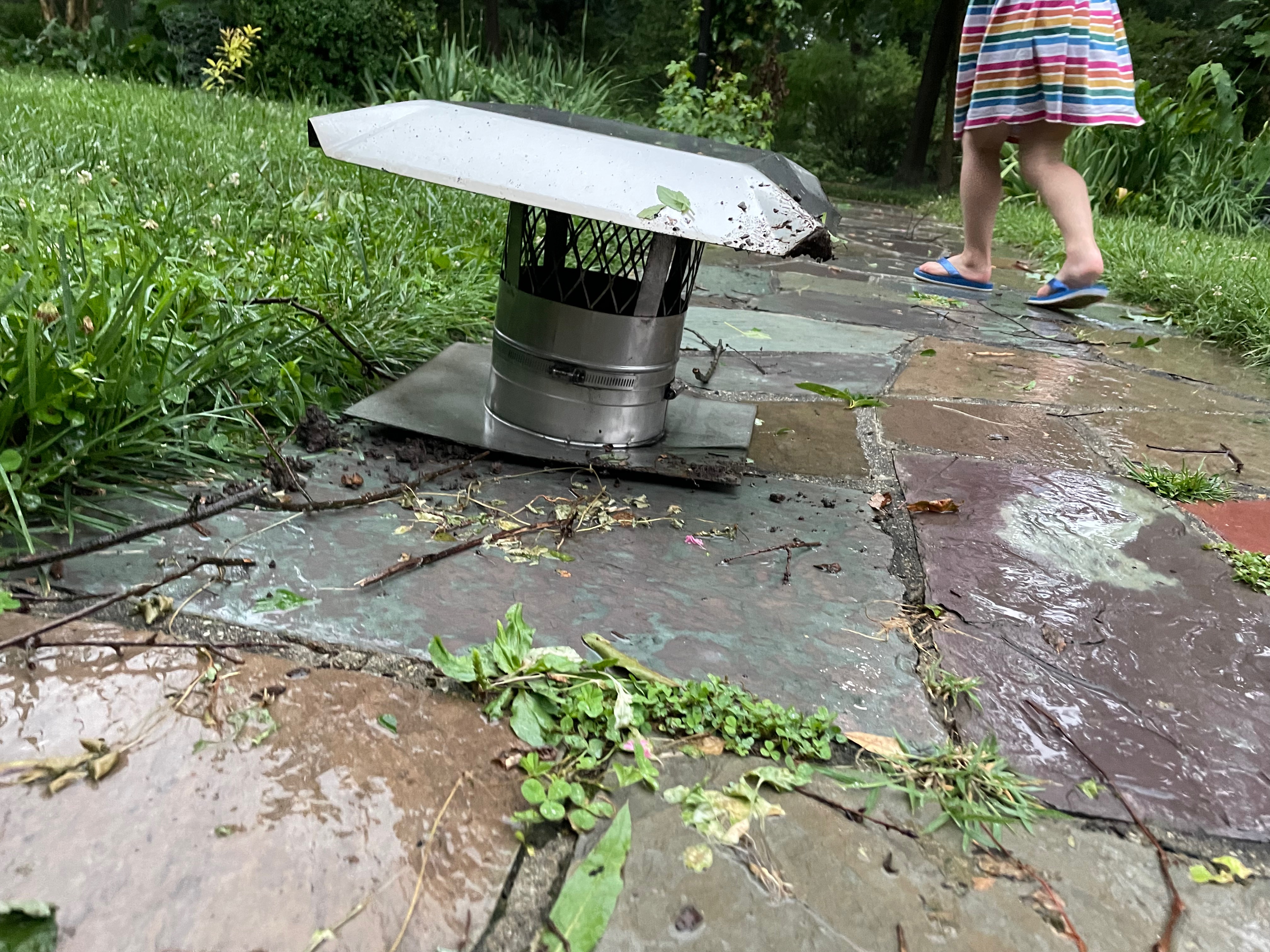
We were lucky that we got out of last storm season relatively unscathed but the heavy winds (or perhaps a flying branch) did manage to knock down one of our three chimney caps. We had them installed after a run-in with a raccoon more than 10 years ago, to make sure that no one else could decide to move in. The one that came down was the one mismatched one of the set of three, and we are pretty sure that it's the one that leads to the furnace, based on our drawings and understanding from that time period (I always swear I'm my own best reader!).


You can see from this picture (as storm clouds continued to roll through) that it's the back-most cap):

The problem is that our chimney sweep, who came to clean our chimneys last fall, said he couldn't get up there to replace it. He did say it was a good-quality cap and suggested it would be possible to paint it (presumably with something heat proof?) rather than replace it with a darker color to match.

All the chimney people look at our slate roof as a huge liability that they simply do not want to deal with and risk breaking. It doesn't help that the cherry tree in front of our house, exactly where they would want to put the ladder, has grown as well. Two companies later, we still haven't found anyone who wants to replace the chimney cap. We're not trying particularly hard, but any time we see someone working around town, we get them to come by and give a quote (a quote that remains: "no thanks, we can't do that job"). So here we are, approximately one year later with no resolution. Fortunately no critters have tried to move in yet.

Friday, June 16, 2023

On milkweed, trees, and grass

Now we head over to the very back corner of our yard, for a look at the last several years of work we've put in back there. It is a shaded and overgrown mess, full of invasive species and poison ivy, so it's not one where we really enjoy working. And it's not visible to anyone but us, so the need to keep it up to avoid embarrassing ourselves is also not a compelling motivation. But still, we're making progress bit by bit.

Step one, back in 2021, was to to sever and remove as much of the wisteria and ivy choking the trees that we could. Wisteria seems impossible to fully eradicate (at least without herbicides), so it keeps on growing up out of the ground. But at least now, it no longer strangles the trees. Removing it required cutting it from its roots and then pulling it off the tree, creating long fibrous vines that were strong enough to swing from!


After learning that this honeysuckle (exact name escapes me) was actually invasive, we pulled that out too. D had wanted to for some time, but I enjoyed the smell. Still, once we learned that it wasn't particularly beneficial to local pollinators, I was glad to be rid of it. 
With the honeysuckle "tree" gone and more weeding on the ground, we ended up with a lot of space to work with. And since the line where the lawn stopped and the "garden" (I use the word very loosely) began always felt like it was right where I needed to stand to push the kids on the swings, we regained some lawn by pushing the railway tie dividers back about 2 feet.
We spread some compost and grass seed and did pretty good with adding more space, as you'll see in the pictures that follow where you can't even really tell there used to be a different border:
So here we are, with a nice cleared place that was much narrower (meaning, we felt, greater likelihood of success for us keeping it looking nice):
When the crew was out doing the patio and the corner not-quite-a-rain garden, we had them put in a birch tree on this side as well:
Well, spoiler alert--it died pretty spectacularly. We tried to complain and have it replaced but never got any satisfaction from the landscaper. We were pretty bummed and also wondered if maybe the spot was bad, though it is usually damp and shady and seemed perfect for a river birch. Then, to jump forward to just last week while we were doing other work in this garden bed, we found this underground, where the birch had been:
This large metal basket, filled with rocks and the tinest bit of soil, was obviously not removed from under the tree when the birch was planned! Of course it died--there was nowhere for its roots to go! They must have been trapped in this small space until they just gave up. SIGH. Ok. Well we just lit that money on fire.

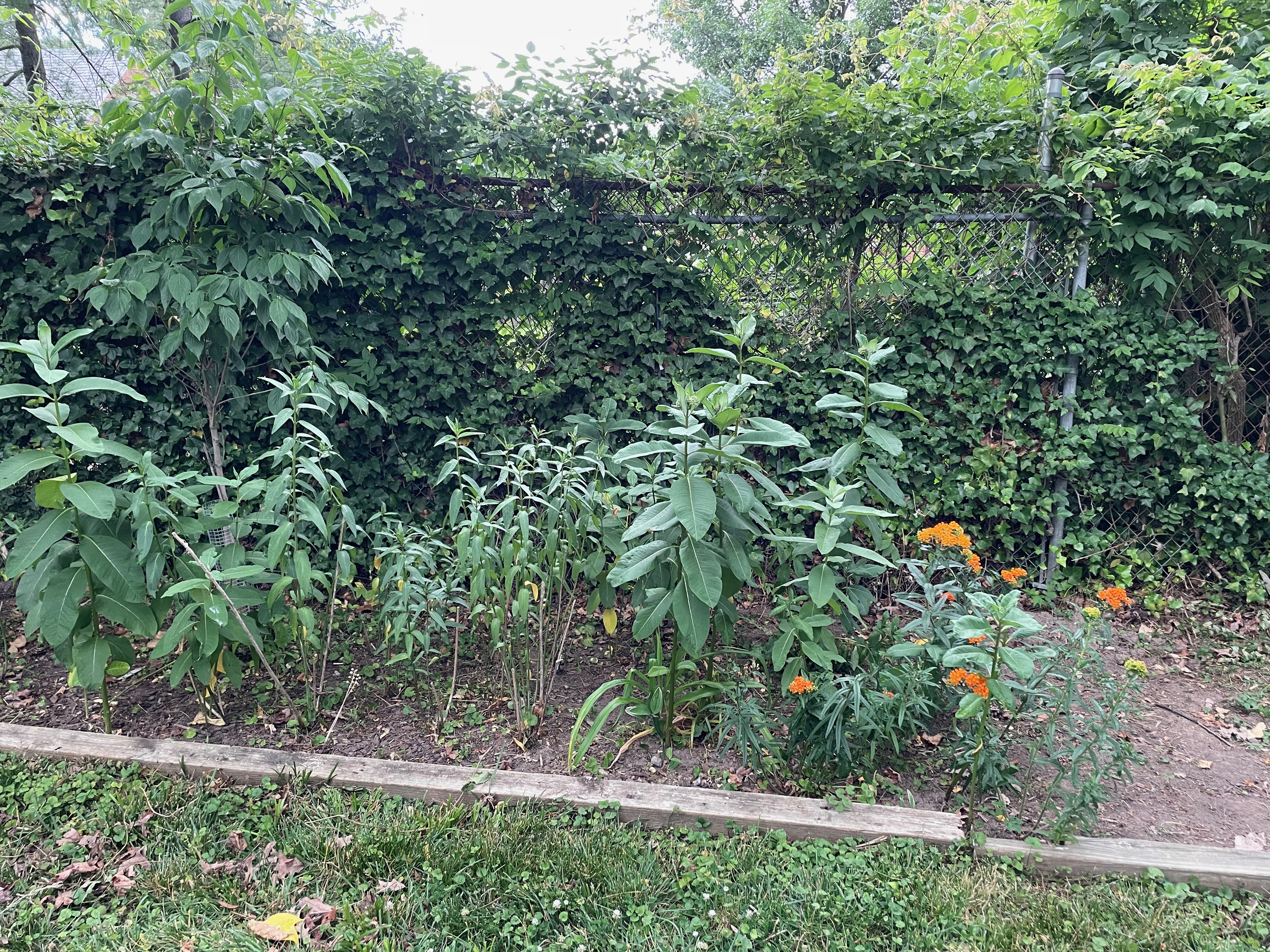
Fortunately, the rest of the back garden bed is doing much better. We planted a slew of different kinds of milkweed: butterfly weed, common milkweed, and swamp milkweed, all native pollinators that monarchs supposedly love (I say supposedly because while they joined us two years ago in our front garden bed, no monarch caterpillars have made a home of this back area. I wonder if it has something to do with the slightly-more-than-dappled shade in this back bed (milkweed prefers sun, but they're surviving admirably back here). Here are some of the milkweed when we planted it in fall of 2021, with the newest arrivals from the nursery circled in red:

And here it is as of last week:
The orange butterfly weed has already flowered but the pink swamp milkweeds are starting to put out buds too. You can see from this angle that we still have a lot of ground we'd like to cover:
Here's what the pink milkweeds will look like, as captured last year:
Also in this back garden bed are a few trees, because I can't help myself. Close to the shed, we planted a sycamore, one of my favorite kinds of trees. We planted in 2021 and here's how tall it was last summer:
From this angle, see it all the way over there on the right?

There's not much for scale, but I'd guess it was maybe about 5 to 6 feet. Fast forward to this year and you can see it's already taller than the shed!
It's quite close to an oak tree, but we had a few arborists suggest that oak tree isn't going to last much longer, so I don't think they will have to compete for long:
We also planted a pair of "stellar" pink dogwoods for some understory color, at the same time as the sycamore:
Sadly, in keeping with our recent 50/50 odds, one of the trees is doing just fine (the one on the left) and the other kicked the bucket. Oh well. I failed to get a picture of it in flower. The best picture I have is one I took to document what kind of tree it was once I realized the band was too tight and had to come off:

More plans for this section include adding more milkweed into the cleared area, possibly planting borage seeds among the milkweed for more ground cover, and keeping the area as clear as we can from weeds and wisteria. We have separate plans for the small section of our garden further to the left (looking at the garden/away from the house), but that's a post for another time.

Sunday, June 11, 2023

Where to begin again...

Posts have been few and far between due to other priorities (knitting, anyone?), life events, and well, because we've been too busy doing things in our home to record them. But we have some big things on the horizon so I might as well catch up with the smaller things over the next few months and try to build some momentum so...hi. We're back.

It's growing season, so as any regular reader will know, it's time for a lawn and garden catch-up. But let's talk about some of the hardware on the way to the outside first. Last fall, we updated some fixtures that put the finishing touches on our siding refresh from spring. Our outdoor lights in the front seemed like they were probably from a discount value pack several decades ago. It was definitely time to swap them out for some curb appeal. The post itself also needed some refresh--it was showing signs of rusting at the top and bottom. I've spray painted it one already, probably almost 10 years ago now (but somehow I couldn't find a post for it when I looked), so that held up pretty well:


After a quick sand-down to remove some of the rust and a wipe with a damp clothed, I went to work applying a few thin coats:
More dramatically, D tackled the electrical work, replacing the topper with one made of clear glass and an Edison bulb (the kind with the exposed filament, a style we've turned to multiple times before, and which you will see again in a future post). This is actually the second post topper, as we originally bought one that was much too high and out of proportion with the rest of the lamp post.
Of course the rest had to be replaced to match! The lamp right next to the door came next:
As always, a mass of old, deteriorating wires greeted us. Nothing too surprising though, so we just proceeded with the new fixture.
Tah-dah! But wait, there's more!
We forgot to get a "before" picture for the light over the garage, but it was similar to the other two, with the plastic shade and black construction. The wires were less deteriorated than next to the front door, but just barely.
Now we have three lovely, matching exterior lights (though the lack of a more sealed-off receptacle does mean things get a little dusty inside).
Coincidentally with all that, our front door hardware abruptly failed one day, almost locking us out. It wasn't the Schlage auto-lock that died (which you might expect, given that it has a battery and small computer) but the mechanism in the doorknob itself that pulls back the latch bolt. It failed pretty spectacularly--D had to uninstall it immediately just so we could get in and out, so it became important that we replace it immediately (the dead bolt still worked independently, fortunately).
Once we went looking, we wondered why we hadn't replaced it sooner. All our front door hardware is brushed nickel, including the storm door handle and our smart lock, and yet we had inherited this oil-rubbed bronze pull (oddly paired with a nickel doorknob on the inside). Why had we kept it so long? I guess it simply wasn't something we had thought of. But the new fixture (on the right) is so much prettier.
Even better, we replaced the slippery inside knob with a lever. This works better for so many reasons! Easier for Grandma (arthritis), me (hand lotion and mittens/gloves), and the kids (tiny hands). Yet another thing we never really considered replacing and yet made a big difference. 

It took one extra try to get right--we were so un-used to levers that we selected the wrong one at first, and had to reinstall the second one that came in the box when we realized which way the lever is supposed to swoop:

And because this is the house of a knitter, it seemed like a good time to upgrade our door wreath too (partly because the UV effects on the old one made all the plastic so brittle it left piles on our floor every time we opened the door):

The lights and handle weren't cheap, but they weren't expensive either. One of those things that can make a big impact in tiny details that seem so obvious afterwards.

Next time, stay tuned for a big yard update as I try to get back in the swing of things.


Friday, November 11, 2022

Mouse trap

It seems appropriate as my little fur baby turns 21 today (yes! 21!) to write about the pests I hinted at in my last two posts. We have had mice problems periodically for a long time in this house. It's an older home with a yard, trees, etc. and, try as we might to seal it up, they always find a way in. But it hasn't typically been a problem because:

2012 picture of my mouser

The only time a mouse made it into our house for real (as opposed to our old breezeway which wasn't even sort of sealed off from the outside) was the harrowing 29 days when this little guy went missing in late 2015.

But our little fur baby has put in his time, and his mousing is not quite up to snuff these days, as he's mostly (if not totally) deaf and a little slow and creaky (but still amazingly fit and healthy for his age). And so back in August, grandma was housesitting for us and sent me a note to say she'd seen a mouse run into the living room (this while she was sitting next to her small, perfectly capable dog, but oh well). It wasn't that we didn't believe her, but we were a little skeptical. We had seen no signs of a mouse eating our food, though we did leave cat food out all night and we had recently noticed an uptick in our cat's appetite...The bowl was now empty many mornings. Hm...

When we got back, and always in the pursuit of hard data, we put up a camera near the cat bowl to see what we could. Many days passed with only the only motion detected being that of our cat. We wondered if grandma had been seeing things. And then:


There were even some videos of a mouse eating some cat food and then scurrying away for a few moments while the cat came in to eat and then coming back to eat more. So I guess our little mouser isn't quite up to the task anymore.

Our first step was to move the cat bowl around and try our best to figure out where the mice were coming in from, but after a couple weeks of this (moving the bowl to the sun room, living room, etc. all while adjusting the camera), we were no closer to figuring out their source.

It was time to start catching them, even if we couldn't figure out how they were getting in. We put out our humane traps, which actually did catch a mouse pretty quickly. 

It also proved to us that he had friends. Another mouse entered video to figure out where his buddy was and how to get him out. Great....

We also realized that they were scurrying out from under the stove/oven and, sure enough, when we moved it out from the wall, we saw a LOT of poo. I had a picture for that but decided it was probably best for you to use your imagination. You're welcome.

We freed that mouse far from our home and then tried again. This time, they were too smart. We never caught anyone else. It was time to call in some professional help and--distressingly--some professional traps. So for a while, we have had to live with a bunch of snap traps, covered at least by a box so no one would accidentally snap them on a finger or toe. Or see something gross when we came down for breakfast in the morning.

And sure enough, these caught some of our visitors. Four in all, so far. Two the very first night that the kill traps went out, then a big one a while later that was maybe living in our walls for a while with all the hoarded food (since we didn't catch him on camera in the interim), then one in the basement.

Our professional pest control expert had one suspicion of how these mice are getting in after looking around the house both inside and out. After all, we've done a lot of work over the years to seal the house up (for energy efficiency as much as for pest control). It turned out that when we had our siding replaced this spring, they did not properly seal the hole where our AC piping goes into the house.

The timing checks out. And we've sealed it up now. So far, so good. But we still have the traps out and set up the camera most nights, after finding basement mouse only 3 weeks ago. We're not quite sure how to know we're done. But however long it takes, our little birthday boy definitely has earned his retirement skritches and getting to keep his food out for whenever he wants to eat.