Please share your opinions and expertise since we need all the help we can get!
Showing posts with label flowers. Show all posts

Saturday, July 11, 2026

Looking shady

We had an opportunity in spring 2025 to get some free plants preselected for a shade garden. And we had plenty of shade now on the side of our addition. We jumped at the chance and started preparing the plot, using old railroad ties to map out the space. We removed the grass and filled it with compost and mulch.
Here's where the space is in our yard, for context:
The plants arrived in April, which apparently was the "right" time to get them in the ground, so we got to work right away:
We received a bunch of tiny plugs, each well labeled. 
The plants we received (from left to right) were: blue wood sedge, golden ragwort, alumroot, wild geranium, goat's beard, blue-stemmed goldenrod, and cardinal flower.

It even came with a planner that suggested exactly how to lay out the garden based on a few common shapes (rectangle border, circle, etc.), so planting was surprisingly simple. Our trapezoid most closely resembled this long rectangle, so that's what we used as our guide:


They looked so tiny!
Here is the garden again that June, three months later, with everything a little bigger:
By August, the time of year when we usually kill all our plants due to our inability to water them, the garden was still looking happy and healthy. We even had some cardinal flowers!

And then last fall, they still were holding on well into November:

Let's fast forward to 2026. Here is early June, with the golden ragwort in bloom:


And now it's July and we're headed back to cardinal flowers! Here's to keeping our garden alive!

Sunday, October 29, 2023

Autumn Petals

When we bought our house in--oh wow this is becoming the far distant past--2009, the gardens were all very spring-bloom heavy. We had mostly azaleas, rhododendrons, and camellias. Oh and LOTS of "decorative liriope grass, of course." Over the years as we've replaced some dying plants and reshaped our flower beds, we've made a point of attemping to plant native pollinators and a three-season garden with lots of food for bees and bugs that make it to fall. When the azaleas, camellias, and our newly planted irises died, the coneflowers, black-eyed Susans, cardinal flowers, milkweed, and bee balm came out. We had made it through summer!

But fall still left a lot to be desired. We had some beautiful volunteer goldenrod that I've cultivated (cultivated as in "didn't cut down"). The bees were clearly happy about that.

Then this spring, in planning for fall, we bought a few varieties of aster that seem to be pretty happy so far! The hot pink ones in front are "vibrant dome" aster. The light purple ones behind are "October skies" aster. In the background, you can also see some unevenly growing mums (they never seem to take off--I think it's too shady there for them). It's so nice to have some color in our fall garden, finally.


It wouldn't be a fall post if we didn't take a quick tour of some of our fall foliage, specifically with our newer trees. After bunnies nibbled a willow oak we'd planted in this very spot in the front yard two years ago, last year (May 2022), I planted this northern red oak, which was already starting out much bigger than our free 6'' willow oak. Based on the description here, it sounded hearty with good odds of survival (I feel like our tree survival rate is about 50%). It was a little floppy so you can see here that a bamboo stake is holding it up--the actual trunk is still just a skinny stick. But even young, this tree seems to be willing to put on a fall show. Here's the tree in early October:

And here it is two days ago. It's like someone flipped a switch and the tree decided it was officially time.
It would be so great to get a big shady oak tree in the front yard, if this fellow survives. It claims to be fast-growing, but I'm not convinced yet. Or at least it doesn't compare to the willow I wrote about in my last post.

Finally, we have an October Glory maple in our back yard, a replacement for the one that the deer got to in 2018. Planted in 2021 at the same time as the sycamore, dogwoods, and the willow, it seems to be doing ok so far, moving from this:

To this:
We were a little worried about its health for a few reasons. First, deer seemed to be nibbling all its lower branches (but, fortunately, aren't rutting its trunk, which we wrapped in chickenwire). Second, this spring we dug it up from its original location and relocated it about a dozen feet away. That always stresses a tree out. This picture, taken in June, shows where the tree is now, closer to the back of our lot. It used to be between the sad magnolia and the house.

Why did we relocated our maple? Well, here's the big news for those that made it to the bottom of the post. We're in the planning stages for the biggest project we've yet taken on: a new addition that will expand the house into the back yard! Now that I've more or less caught you up on the state of the yard, I'll write a series of posts bringing you up-to-date on a completely new addition that will expand our footprint all the way to the magnolia. We're so excited!

Friday, June 16, 2023

On milkweed, trees, and grass

Now we head over to the very back corner of our yard, for a look at the last several years of work we've put in back there. It is a shaded and overgrown mess, full of invasive species and poison ivy, so it's not one where we really enjoy working. And it's not visible to anyone but us, so the need to keep it up to avoid embarrassing ourselves is also not a compelling motivation. But still, we're making progress bit by bit.

Step one, back in 2021, was to to sever and remove as much of the wisteria and ivy choking the trees that we could. Wisteria seems impossible to fully eradicate (at least without herbicides), so it keeps on growing up out of the ground. But at least now, it no longer strangles the trees. Removing it required cutting it from its roots and then pulling it off the tree, creating long fibrous vines that were strong enough to swing from!


After learning that this honeysuckle (exact name escapes me) was actually invasive, we pulled that out too. D had wanted to for some time, but I enjoyed the smell. Still, once we learned that it wasn't particularly beneficial to local pollinators, I was glad to be rid of it. 
With the honeysuckle "tree" gone and more weeding on the ground, we ended up with a lot of space to work with. And since the line where the lawn stopped and the "garden" (I use the word very loosely) began always felt like it was right where I needed to stand to push the kids on the swings, we regained some lawn by pushing the railway tie dividers back about 2 feet.
We spread some compost and grass seed and did pretty good with adding more space, as you'll see in the pictures that follow where you can't even really tell there used to be a different border:
So here we are, with a nice cleared place that was much narrower (meaning, we felt, greater likelihood of success for us keeping it looking nice):
When the crew was out doing the patio and the corner not-quite-a-rain garden, we had them put in a birch tree on this side as well:
Well, spoiler alert--it died pretty spectacularly. We tried to complain and have it replaced but never got any satisfaction from the landscaper. We were pretty bummed and also wondered if maybe the spot was bad, though it is usually damp and shady and seemed perfect for a river birch. Then, to jump forward to just last week while we were doing other work in this garden bed, we found this underground, where the birch had been:
This large metal basket, filled with rocks and the tinest bit of soil, was obviously not removed from under the tree when the birch was planned! Of course it died--there was nowhere for its roots to go! They must have been trapped in this small space until they just gave up. SIGH. Ok. Well we just lit that money on fire.

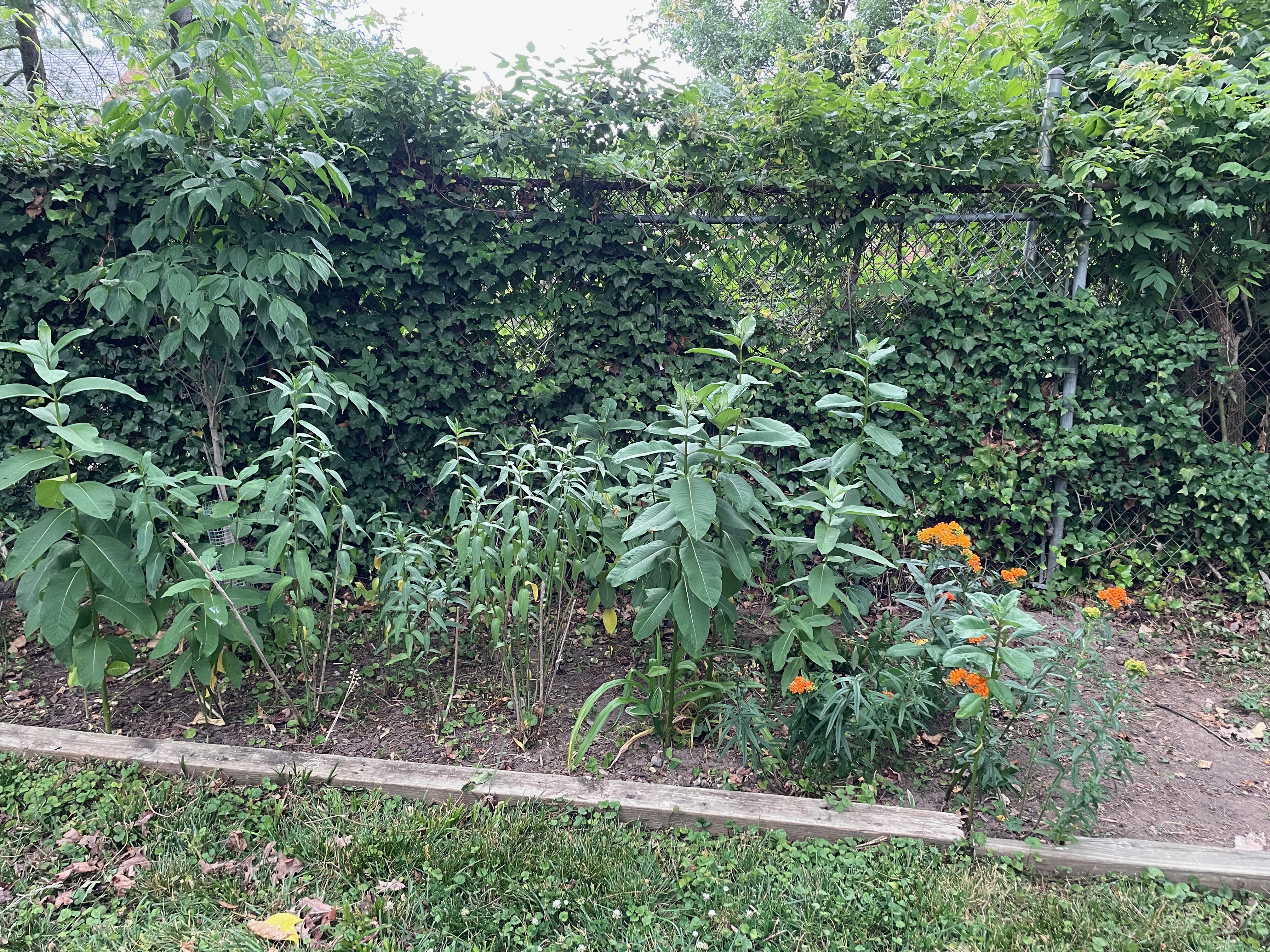
Fortunately, the rest of the back garden bed is doing much better. We planted a slew of different kinds of milkweed: butterfly weed, common milkweed, and swamp milkweed, all native pollinators that monarchs supposedly love (I say supposedly because while they joined us two years ago in our front garden bed, no monarch caterpillars have made a home of this back area. I wonder if it has something to do with the slightly-more-than-dappled shade in this back bed (milkweed prefers sun, but they're surviving admirably back here). Here are some of the milkweed when we planted it in fall of 2021, with the newest arrivals from the nursery circled in red:

And here it is as of last week:
The orange butterfly weed has already flowered but the pink swamp milkweeds are starting to put out buds too. You can see from this angle that we still have a lot of ground we'd like to cover:
Here's what the pink milkweeds will look like, as captured last year:
Also in this back garden bed are a few trees, because I can't help myself. Close to the shed, we planted a sycamore, one of my favorite kinds of trees. We planted in 2021 and here's how tall it was last summer:
From this angle, see it all the way over there on the right?

There's not much for scale, but I'd guess it was maybe about 5 to 6 feet. Fast forward to this year and you can see it's already taller than the shed!
It's quite close to an oak tree, but we had a few arborists suggest that oak tree isn't going to last much longer, so I don't think they will have to compete for long:
We also planted a pair of "stellar" pink dogwoods for some understory color, at the same time as the sycamore:
Sadly, in keeping with our recent 50/50 odds, one of the trees is doing just fine (the one on the left) and the other kicked the bucket. Oh well. I failed to get a picture of it in flower. The best picture I have is one I took to document what kind of tree it was once I realized the band was too tight and had to come off:

More plans for this section include adding more milkweed into the cleared area, possibly planting borage seeds among the milkweed for more ground cover, and keeping the area as clear as we can from weeds and wisteria. We have separate plans for the small section of our garden further to the left (looking at the garden/away from the house), but that's a post for another time.

Sunday, September 25, 2022

Flipping the Bird

I was working from home recently, at my sewing table/desk in the guest room. The windows were open and I could hear the birds chirping and the bees buzzing. I love that some volunteer goldenrod has planted itself in this garden bed. It starts growing in late August and really fills in between all the plants that have already died for the year.
Being a late summer/early fall flower, it attracts a lot of bees and other pollinators at a time when there isn't much else for them to eat.
But suddenly, instead of happy chirping, I heard what sounded like a birdy rumble outside. A bluebird and a woodpecker were obviously having a loud argument in the Hawthorne tree just outside the window. There was some kind of turf war going on. The woodpecker eventually flew off in a huff.

Then I heard tapping. Very quiet tapping, at least from my vantage point inside. It went on for at least a minute. We snuck around from the back door to the front to see that same woodpecker, apparently taking out his aggression on our front facade. See him there?
In about two minutes, this little jerk put three sizable holes (two pictured here) in our door! From what I was able to surmise from reading why a woodpecker might have done this, it was likely the conclusion of the turf war, as a way to send a big FU to the bluejay. And a big FU to us too.

We filled the holes quickly to discourage the bird from coming back, but I don't think this woodpecker was trying to build a hole for a nest or find insects, so hopefully he has admitted defeat and moved on. Unfortunately for us, matching the paint is going to be challenging. Apparently I failed to note the color in my 2017 post when we last had our exterior painted. Honestly I may never had known the color. I'm going to scavenge our basement paint collection and hope I can find it. If not, it may require a lot of paint swatches just for a repair no bigger than a quarter.

And this isn't even the biggest pest problem we're experiencing right now. Stay tuned...

Thursday, July 21, 2022

Summer Garden

Last fall we uprooted a lot of plants from our front garden to fill it with native pollinators. We had two goals. The first, of course, was to get rid of invasive species and plant things that will attract and nourish birds, bees, and butterflies. The second was to plant things that could thrive in our native soil and with our local weather. So it seems like a good idea to check in, now when our garden should be in full bloom.  Let's compare:

Last fall, we planted cardinal flower

Now, with lots more color!

Let's break it down. Starting at the leftmost edge, near our troublesome downspout, here's the view last fall:

And here it is now (the angle is a little different to highlight some of our less successful areas):
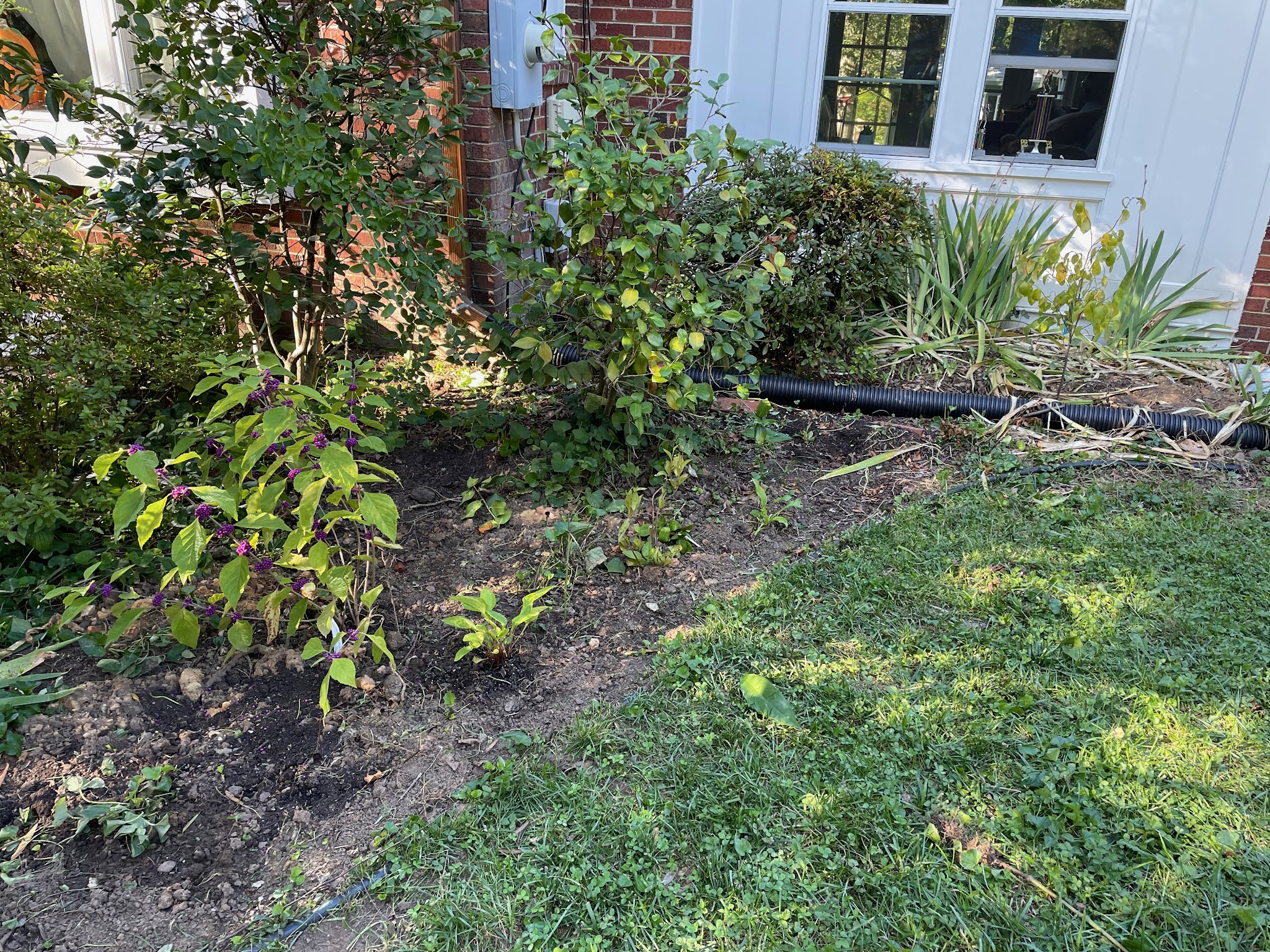
Visible here should be a few different varieties of milkweed but our "Red Butterfly" Asclepius doesn't seem to have come back, just the swamp milkweed. The American Beautyberry is also looking pretty sad:
Just some spindly twigs. We tried loosening up the earth last weekend (it was packed down, maybe due to some of the water drainage issues) and are wondering if there is simply too much sun here to grow certain types of plants. It's clear this corner still needs some work, we're just not sure exactly what.

Moving along, here's the fall view:
You can scroll back up to see the first summer picture for a good overall scene of this, but here are my favorite images to capture this section:


Coneflower (echinacea), Black-eyed Susans (Rudbeckia), and cardinal flowers (Lobelia cardinalis) all came back, as did some of the Russian sage. The bee balm (monarda) "Jacob Cline" came back too--about a month before the rest so it's already on the way out. 

Moving to the garden on the other side of the house, here's fall:
And here's summer. It's not particularly exciting because the deer seem to have gotten to the yellow Black-eyed Susan flowers but at least the plants themselves seem to have survived.
Then further down, we planted more Black-eyed Susans, another Beautyberry bush, and a Linder Benzoin "spicebush":
Many of the Black-eyed Susans have come back and this Beautyberry bush is looking very happy, unlike the one on the other side of the house. No little purple berries yet, but that's to be expected. It blooms in June and July and grows berries in August and September, so we're right on track.
Here's the spicebush--not particularly exciting at the moment. It's not even taller than our iris greens. But on the other hand, it is green and not wilting or anything so I'l call that a win. I do hope it gets bigger though, since a quick google search suggests that it can grow 1-2' a year and this little guy has barely budged.
Given our track record, I'd call this a success so far. One corner of the garden really seems to be struggling as is the Hawthorn tree nearby (more on that later), so maybe that side of the house just doesn't have enough...something (not sure what that something is). But the rest seems relatively happy and full of native pollinators.