Please share your opinions and expertise since we need all the help we can get!
Showing posts with label garden. Show all posts

Saturday, July 11, 2026

Looking shady

We had an opportunity in spring 2025 to get some free plants preselected for a shade garden. And we had plenty of shade now on the side of our addition. We jumped at the chance and started preparing the plot, using old railroad ties to map out the space. We removed the grass and filled it with compost and mulch.
Here's where the space is in our yard, for context:
The plants arrived in April, which apparently was the "right" time to get them in the ground, so we got to work right away:
We received a bunch of tiny plugs, each well labeled. 
The plants we received (from left to right) were: blue wood sedge, golden ragwort, alumroot, wild geranium, goat's beard, blue-stemmed goldenrod, and cardinal flower.

It even came with a planner that suggested exactly how to lay out the garden based on a few common shapes (rectangle border, circle, etc.), so planting was surprisingly simple. Our trapezoid most closely resembled this long rectangle, so that's what we used as our guide:


They looked so tiny!
Here is the garden again that June, three months later, with everything a little bigger:
By August, the time of year when we usually kill all our plants due to our inability to water them, the garden was still looking happy and healthy. We even had some cardinal flowers!

And then last fall, they still were holding on well into November:

Let's fast forward to 2026. Here is early June, with the golden ragwort in bloom:


And now it's July and we're headed back to cardinal flowers! Here's to keeping our garden alive!

Sunday, July 23, 2023

Lawn and Murder Bees

Last summer, we (well, mostly I), continued to tend our vegetable garden. After protecting the garden with chickenwire and closing it off like Fort Knox to keep the rabbits out after they decimated my snap peas in 2021, we did manage to keep out most of the yard herbivores and harvest some things. Here, for example, is one of our tomato harvests. (I have many more harvest pictures from 2022 but this post isn't really about that, so imagine radishes and cucumbers too.)

The fact was, however, I didn't really enjoy gardening (at least not after it got about 75 and the mosquitos came out) and the kids did not want to help and, well, it was much easier just to buy those veggies from the store. Things had become a little wild by the end of the summer as I went out less and less to avoid being assaulted by biting insects:

So last fall, we made the rewarding decision to give up on veggie gardening and turn it back into yard:

This summer, it was a lovely patch of grass (and not even the weed-filled grass of the rest of the yard, yet). Though we tried to level it as best we could, it is still a little mounded, but hopefully as the tilled ground compacts, it will mostly be level with the rest of the yard. And really it probably is only noticeable to us.
All was well. We spent our limited gardening time in our flower beds along the front of the house and the back fence line, slowly trying to build out our pollinator-friendly spaces.

Until...the yellow jackets came...D noticed some activity in the lawn while watering the back garden a few weeks ago. He had mildly angered...some buzzing things...and went over to investigate. About 10 feet away from the activity, he got  a stinger to the neck and turned tail and headed indoors. After asking some neighbors and doing some research, he learned that they were most definitely not ground bees, which are solitary (and usually stingless, which these assuredly were not), but likely a yellow jacket nest. Yellow jackets are aggressive and really not something you want to mess with. And while they can excavate their own hole, they will often find space where the ground is looser or even dug out by something like a groundhog. Like the soft earth of our former veggie garden! UGH.

They had moved in right at the edge of that new patch of grass. Here are a few pictures of their nest location, from a safe distance away (including inside through a screened window--I was taking no chances):


The holes can be incredibly small and they can possibly have multiple entrances, but the primary suggestions for how to eradicate them included pesticides and suffocation. D figured out that they were dormant/sleeping at night and that it was possible to attempt to cover up the hole until pest professionals could come and take care of it. He covered up the (main? only?) entrance with a bucket and a brick. Here is a zoomed in video, taken from afar, of the angry yellow jackets the next morning:


That was a lot of NOPE right there. A couple of weeks after D made the painful discovery, professional help arrived. Wearing a bee-keeper hat and thick clothes, he widened the hole that served as the entrance put chemicals in.


He warned us to be on the lookout for holes created by other animals that can serve as a starting point for yellow jackets, and to fill them in and stomp on them. Two days later, we've seen no activity from that nest, thank goodness. 

Edited, one hour after originally posting, to add:

We found another. Fuuuuuuuuddddggggge. Since it's in the median, we're checking to see if it's our municipality's problem or ours. (Further edited to add - the town will take care of it, yay!)

Thursday, July 21, 2022

Summer Garden

Last fall we uprooted a lot of plants from our front garden to fill it with native pollinators. We had two goals. The first, of course, was to get rid of invasive species and plant things that will attract and nourish birds, bees, and butterflies. The second was to plant things that could thrive in our native soil and with our local weather. So it seems like a good idea to check in, now when our garden should be in full bloom.  Let's compare:

Last fall, we planted cardinal flower

Now, with lots more color!

Let's break it down. Starting at the leftmost edge, near our troublesome downspout, here's the view last fall:

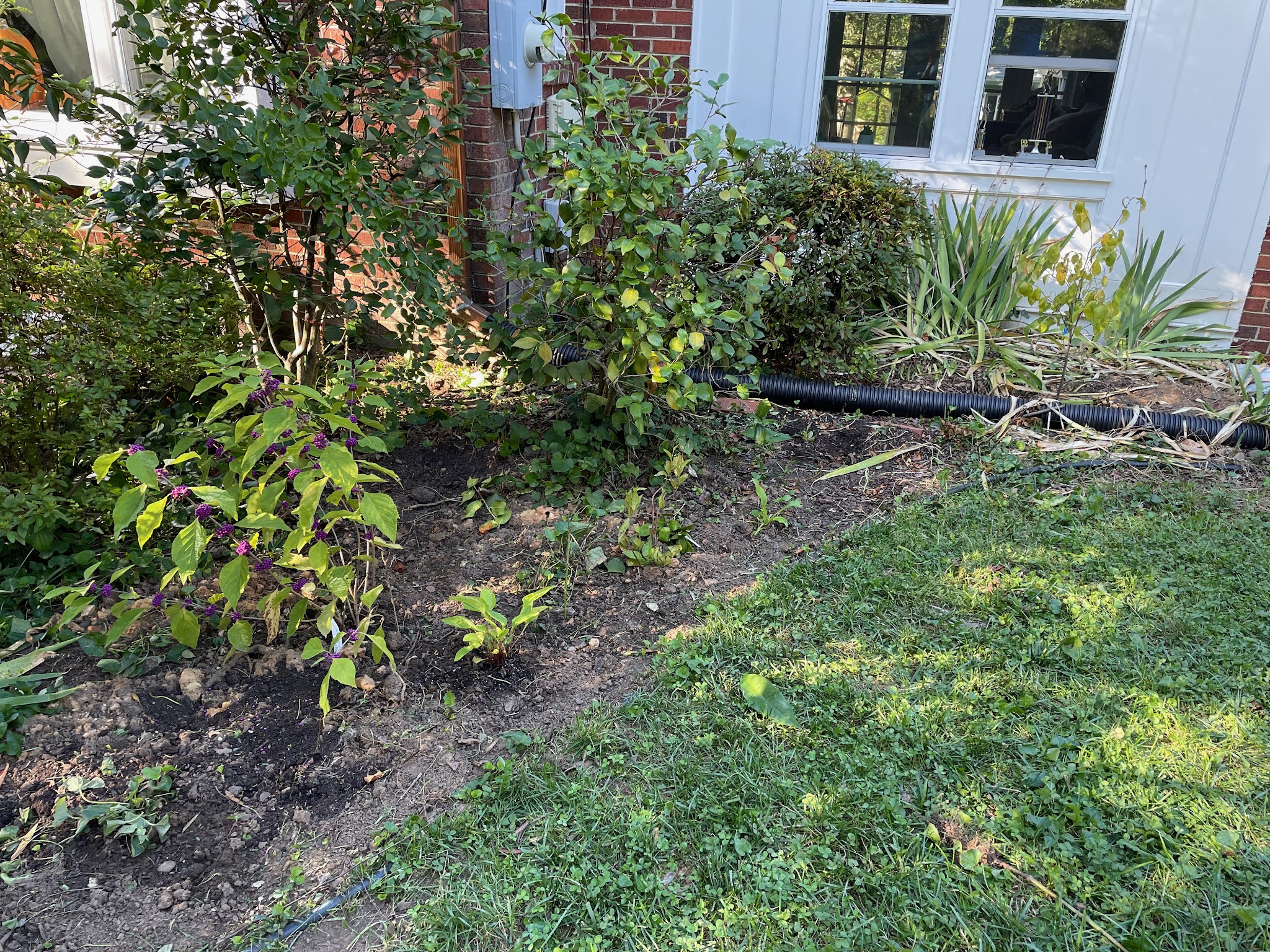
And here it is now (the angle is a little different to highlight some of our less successful areas):
Visible here should be a few different varieties of milkweed but our "Red Butterfly" Asclepius doesn't seem to have come back, just the swamp milkweed. The American Beautyberry is also looking pretty sad:
Just some spindly twigs. We tried loosening up the earth last weekend (it was packed down, maybe due to some of the water drainage issues) and are wondering if there is simply too much sun here to grow certain types of plants. It's clear this corner still needs some work, we're just not sure exactly what.

Moving along, here's the fall view:
You can scroll back up to see the first summer picture for a good overall scene of this, but here are my favorite images to capture this section:


Coneflower (echinacea), Black-eyed Susans (Rudbeckia), and cardinal flowers (Lobelia cardinalis) all came back, as did some of the Russian sage. The bee balm (monarda) "Jacob Cline" came back too--about a month before the rest so it's already on the way out. 

Moving to the garden on the other side of the house, here's fall:
And here's summer. It's not particularly exciting because the deer seem to have gotten to the yellow Black-eyed Susan flowers but at least the plants themselves seem to have survived.
Then further down, we planted more Black-eyed Susans, another Beautyberry bush, and a Linder Benzoin "spicebush":
Many of the Black-eyed Susans have come back and this Beautyberry bush is looking very happy, unlike the one on the other side of the house. No little purple berries yet, but that's to be expected. It blooms in June and July and grows berries in August and September, so we're right on track.
Here's the spicebush--not particularly exciting at the moment. It's not even taller than our iris greens. But on the other hand, it is green and not wilting or anything so I'l call that a win. I do hope it gets bigger though, since a quick google search suggests that it can grow 1-2' a year and this little guy has barely budged.
Given our track record, I'd call this a success so far. One corner of the garden really seems to be struggling as is the Hawthorn tree nearby (more on that later), so maybe that side of the house just doesn't have enough...something (not sure what that something is). But the rest seems relatively happy and full of native pollinators.

Sunday, October 17, 2021

If You Plant It, They Will Come

Last year, we planted butterfly weed, milk weed, and swamp milk weed (all related plants in the Asclepias genus) in the hopes of attracting some monarchs. They bloomed beautifully and attracted a lot of pollinators. See the bee in the second photo? Bees and other bugs were frequent visitors of the bright orange flowers.
 
And then...and THEN the monarchs found us! We saw one caterpillar first, and watched it for almost two weeks before it wandered off, either eaten by a bird or exploring to find a place for its chrysalis (apparently they don't create their chrysalis on their milkweed plant). We loved watching it make its way around the leaves, chomping everything in its wake.

Inspired by a neighbor who raised their monarch caterpillars into butterfly-hood in an enclosure (and borrowing their cage for a few weeks), we decided to raise the other two caterpillars that found their way onto our butterfly weed.

We learned, among other things, that they produce a LOT of poop:
Guess Eric Carle left that part out of The Very Hungry Caterpillar. Not sure why though--kids LOVE to talk about poop.

Then the special day arrived, when the first of our two caterpillars, Stripy, turned into a chrysalis. We actually missed the big moment but we know it took less than two hours from when we saw him last. First caterpillars start to curl up in a "J" shape and expel some sticky webbing that is what the chrysalis hangs from:

And then poof! Chrysalis. Sushi, caterpillar number two, joined Stripy about a week later. Sushi's chrysalis got blown off the spot where he mounted his webbing. Fortunately the chrysalis itself didn't look like it was damaged in the fall, so we did a lot of internet research on how to create a new mount for the chrysalis (spoiler alert - it worked, sort of!). And let us get some funny pictures of a chrysalis held in place with a binder clip and dental floss:
Fast forward 10-14 days from when they were caterpillars and the chrysalises became so clear that we could see the butterfly, almost ready to emerge, inside it (this one is Stripy, still safely stuck to her original location):
And then--BUTTERFLY!
You can see Sushi's chrysalis hanging in the background in this picture of Stripy, who we think is a female monarch because it doesn't have black dots on its lower wings.


Sushi emerged about a week later. His wing (because he was a "he" based on those little dots) looked a little misshapen, possibly from the chrysalis fall, but he did manage to fly away, so the rest is up to him/nature.
Back to the plants themselves. The first place that we planted butterfly weed clearly was not the place for them, since they fell into the sidewalk and driveway. We're planning to move them this winter to somewhere with more space, likely to the garden under the guest room window, that just got its native plant makeover. In a future post, I'll also show you the butterfly weed and milkweed that we planted in the backyard from plugs.
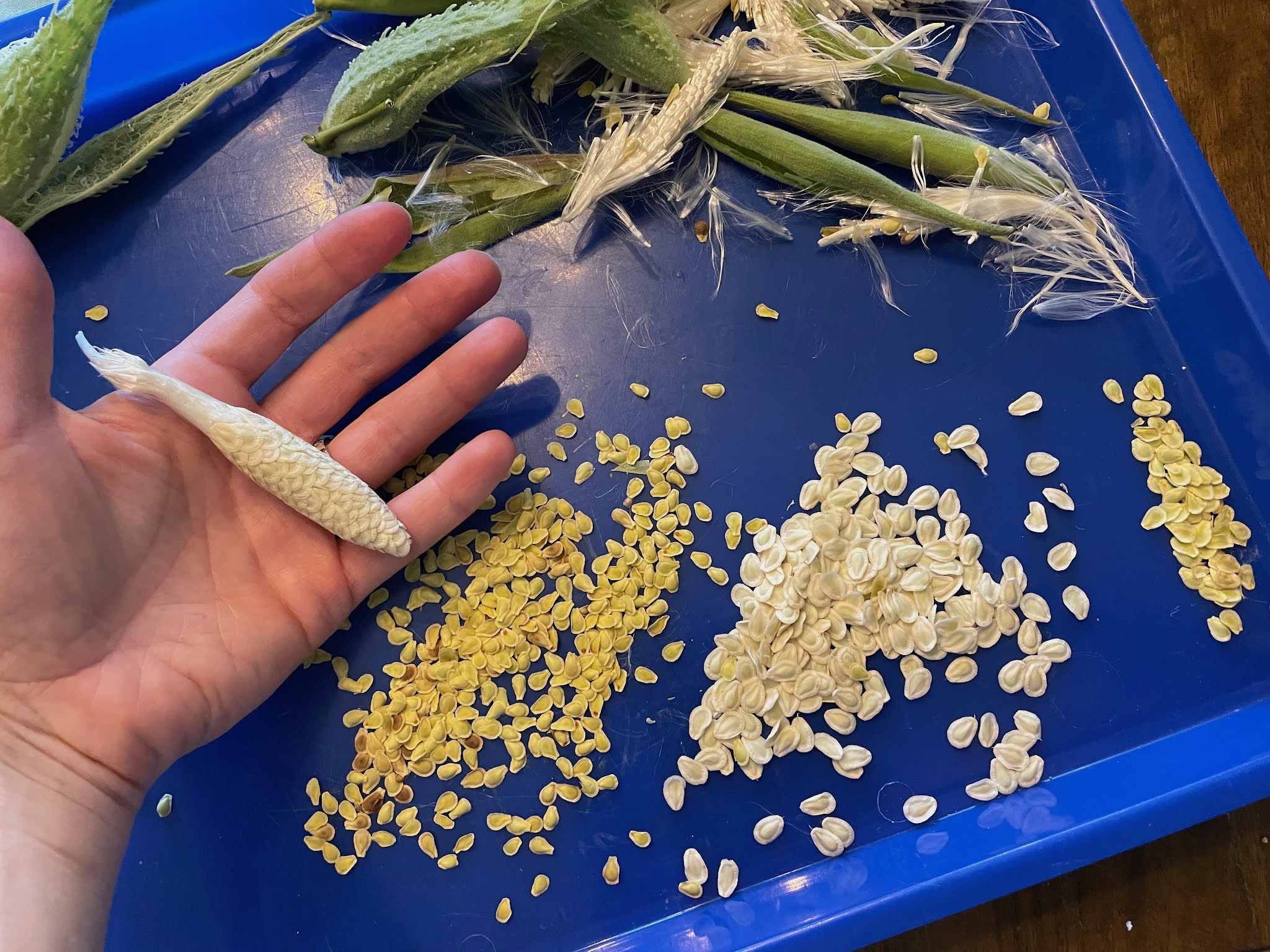
But our new obsession with milkweed (because LOOK! now we got butterflies!) meant that I decided to try to plant a bumper crop on my own from the pods. If nothing else, they were fun to slice open and harvest, and once the seeds were separated, the kids had a great time blowing the fluff around the yard.


I took seeds from slightly different times of the summer and from different varieties of Asclepias since I wasn't sure when they would be "ready." I know they need to overwinter in colder soil before they start to germinate, so we won't really know if it worked until spring. Fingers crossed!

Thursday, September 30, 2021

Native-born

 In the summer, we were too hot and unmotivated to do any home improvements. Now as the weather turns to fall, we're too busy WITH home improvements to post about them. Well, yard improvements anyway. Tis the season to plant! We have a lot of goals for the yard and garden this fall. The first was to mostly gut and re-plant this garden bed. 

I really thought I'd taken a good before picture, but I did not--this wasn't even supposed to be a picture of this garden--it's of the maple tree in front of it. But you can see how overgrown the garden is behind it. It wasn't just overgrown, it was full of plants that never really thrived, or ones that we decided we didn't like. Just about the only plants there that were happy AND beautiful were the rose bushes (which we planted) and the camellias (which we inherited from the previous owners).

Now we've already done a dramatic garden remodel once, when we took out as much of the dreaded liriope "border" as we could, because it had taken over the garden entirely (we STILL find liriope in the garden to this day but I rip it out whenever I can and it's only in small spots). The Black-eyed Susans that we planted in 2014 and had done so well were in a disastrous state thanks to being eaten and likely also being crowded out with weeds. Weeding around them is very hard because the little violets that have invaded look similar at first glance to the leaves of a Black-eyed Susan, except more heart shaped. Here's an example where I was weeding - the yellow outlines are for the flowers and the red are for the weeds.
The "weeds" do make cute flowers for a small portion of the year - here's an example from spring. But they are invasive and take out and aren't particularly good pollinators or valuable, so this year I finally decided to do battle with them. Among other things.
So onto the garden makeover after that aside about weeding. We did a lot of weeding, but we did much more than that.

Besides the gardens just looking "messy," the main reason we started over was to refocus our garden beds on native pollinator plants. We had a great time learning about what was local (which, as an added bonus, should mean that they are hardy!).

Here is the full view of the left garden:

And here it is in parts. In this picture, besides the rose bushes (and a few tree seedling that planted themselves that we plan to try to transplant this winter), there are, from left to right:

Callicarpa Americana "American Beautyberry," Asclepias "Red Butterfly" and Asclepias swamp milkweed (more on these later), and Lobelia "Cardinal flower":

Moving along, there's some Russian sage to add to one very leggy one that we planted years ago that had been struggling as it was crowded out, there's the camellia and hosta that was already there, and then bee balm monarda "Jacob Cline." All along the front, we refreshed the Black-eyed Susans (Rudbeckia) and cone flowers (echinacea) too.
We are doing less of a major overhaul in the right garden, but we did some major weeding and mulching (all those pesky violets) and rebuilding the Black-eyed Susans and coneflowers. We also used some of our leftover patio bricks to make some pretty edging.

Further down in that garden, we cleared some space of unwanted plants and put in a second beautyberry bush (these plants produce beautiful purple berries that the kids are really enjoying playing with, being mixed into concoctions or used as props for "fairy houses"--thank goodness they are past the age where I'm concerned someone might eat one). The other major change here was replacing our butterfly bush with an as-yet-very-tiny Lindera Benzoin "spicebush" - it's the little yellowish green plant on the right side of this picture. It should eventually get big enough to cover our window and give us some good privacy like our butterfly bush did, but is ACTUALLY attractive to--and healthy for--butterflies and a better part of our local ecosystem. Some very smart friends helped educate us that our purple-flowered butterfly bush, while pretty, was invasive, crowding out local pollinator plants, while not being particularly helpful to butterflies during their whole lifecycle (more info here).

We still have three more Lobelia to plant, this time a deep magenta "Starship Deep Rose" (I would love to have the job of naming these, but I suspect I'd have to be able to actually invent/discover these variants to do so) in addition to our new our red ones. 

I'm so excited about our new garden and hoping that they stay alive and flourish. Even better if they manage to attract all the pollinators that we hope to attract, like bees, hummingbirds, and butterflies (more on butterflies soon!). And best of all, we debated at length whether we should hire someone to do this project and we did it ourselves in three weekends and about $300 in plants.